Dental Implants for Oak Park Patients
If you want to restore your smile by fixing missing teeth, implants from Murphy Dental Group, PLLC can help improve the appearance of your smile! As an experienced cosmetic dentist, Dr. Murphy has successfully treated many patients with implants to give them beautiful, natural-looking smiles. Call us today to schedule a consultation and discuss dental implants in Oak Park!
Beautiful Replacement Teeth That Feel Natural
Whether you’re missing just one tooth or multiple teeth, dental implants are quickly becoming the standard restorative dentistry solution. Dental implants from an Oak Park dentist like Dr. Murphy provide a natural, long-lasting solution for your missing tooth. If you care for your implant properly, it will last you for the rest of your life. At our practice, we use the latest implant dentistry technology and techniques to deliver top-notch patient care for tooth replacement in Oak Park
Understanding Dental Implants: A Two-Part Restoration
Dental implant treatment involves two distinct components working together to fully replace a missing tooth: the surgical placement of the implant itself, and the restoration that completes it. Understanding how these two stages fit together can help you know what to expect at each step of your treatment, from your first consultation through your final restored smile.
Surgical Implant Placement
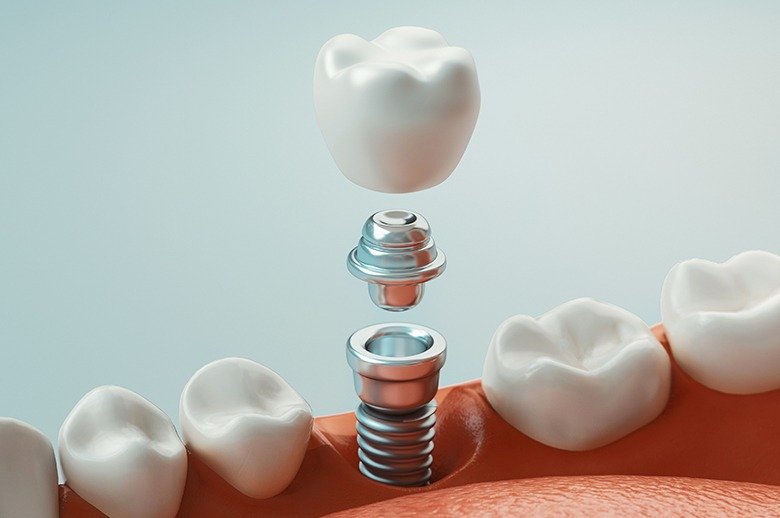
The implant is a small titanium or zirconium post shaped like a screw or rod. These materials are chosen because they are biocompatible, meaning your body accepts them without rejection, which allows the post to bond securely with living bone.
At Murphy Dental Group, PLLC, this surgical stage is performed in-office by two experienced providers, giving patients access to skilled surgical care without being referred out to a specialist. During placement, a small incision is made in the gum line and the implant post is positioned directly into the jawbone, replacing the root of the missing tooth. The site is then cleaned and sutured to begin healing.
Over the following 3-6 months, the implant undergoes osseointegration, the process by which it fuses permanently with the surrounding jaw and gum tissue. During this healing window, the bone actually grows around and bonds to the surface of the post, creating a stable, long-lasting foundation strong enough to support a natural bite. This is the same biological process that makes implants far more durable than older tooth-replacement options like bridges or dentures.
Implant Restoration
Once osseointegration is complete and your provider confirms the implant has fully bonded with the jawbone, attention shifts to the restoration, the visible part of the implant that replaces the tooth itself. This is typically a custom-crafted crown, though implant-supported bridges or dentures may be used for patients missing multiple teeth.
Building the restoration is its own detailed process. Your restoring provider takes precise impressions or digital scans of your mouth, then works with a dental lab to design a crown or prosthetic that matches the size, shape, and shade of your surrounding teeth. Once it’s ready, the restoration is permanently attached to the implant post using a small connector piece called an abutment, securing it firmly in place.
Together, the surgically placed implant and the custom restoration function as a single unit, replacing both the root and the visible tooth for a result that looks, feels, and performs like a natural tooth.
The Dental Implant Placement Process
Once Dr. Murphy has approved you as an eligible candidate for the dental implant procedure, the dental implant process typically takes two appointments. During your consultation, Dr. Murphy uses advanced x-rays and scanning technology to develop a customized treatment plan just for you. Then, at your first appointment, he will clean and numb your mouth. If sedation dentistry is necessary, a form of sedation can be administered to the patient at this time.
During this next step of the surgical procedure, a small incision is made in your gum line, and the dental implant is placed directly into this area. The area is then cleaned again and sutured. As your dental implant heals for about 3-6 months, Dr. Murphy will create a custom crown that matches your existing healthy teeth perfectly. Once enough time has passed, and your implant has healed completely, you’ll come in for your last appointment. During this appointment, Dr. Murphy will permanently attach your crown to the dental implant, and ensure that it fits perfectly and matches your adjacent teeth. You’ll leave our office with a beautifully restored smile!
Does It Hurt To Get A Dental Implant?
No. Your mouth will be completely numb during the dental implant placement process, and we also provide sedation dentistry at our office to keep you safe and comfortable. You won’t feel any pain or discomfort during the implant process itself.
However, you can expect some pain when your numbing and sedation wear off, and you go home to recover. Dr. Murphy will provide you with a set of instructions to follow to minimize your pain and ensure your mouth heals properly after your dental implant surgery in Oak Park, so follow his instructions closely.
How Long Do Dental Implants Last?
If you take proper care of your mouth and follow Dr. Murphy’s instructions to recover and heal after your implant placement surgery, you can expect the implant to bond permanently with your gums and jaw bone. It will never fail as long as you brush and floss and keep your mouth healthy.
In fact, up to 90% of implants are still in place after 30 years. It’s likely that you will be able to keep your dental implant for the rest of your life, making this by far the best way to permanently restore your missing teeth.
To make sure your dental implant in Oak Park lasts as long as possible, though, it is very important to maintain good at-home oral hygiene, and to see Dr. Murphy every six months for an oral exam and dental cleaning.
This helps you avoid “peri-implantitis,” an infection around your implant that’s similar to gum disease. Peri-implantitis is the leading cause of premature dental implant failure, and should be avoided at all costs.
It’s important to note that restorative dentistry procedures, such as dental crowns, implant-supported bridges, and implant-supported dentures, may wear out over time. Unlike the metal implant post, which is securely held into your gum and jaw tissue, your restorations will be exposed to wear and tear from daily biting, chewing, and speaking. They usually must be replaced every 10-20 years.
What Happens If I Damage An Implant?
In most cases, damaging an implant just means that you’ve damaged the implant restoration, such as the crown, bridge, or denture attached to your dental implant or implants. The implant itself, the small piece of metal that supports your restoration, will likely be intact and undamaged.
As previously mentioned, dental implant restorations are subject to a lot of wear and tear. Over time, a restoration like a dental crown may become damaged or worn out as it’s used to chew and bite. For example, you could crack the crown when biting a popcorn kernel, or it may be knocked loose if you slip and fall and suffer dental trauma.
The good news is that it’s very easy to replace and repair damaged implant restorations. Dr. Murphy will be able to easily repair the damaged tooth or teeth, and restore your smile, usually in only a single emergency dentistry appointment at Murphy Dental Group, PLLC.
It’s very rare for the metal implant post to become damaged, because it’s tightly bonded to your gums and jaw tissue. Unless your implant heals improperly or you experience major dental trauma, your implant will likely never become damaged and require replacement.
Interested In Oak Park Dental Implants? Contact Us Today!
Dental implants can last for the rest of your life, if cared for properly. They also look and feel completely natural, unlike dentures and bridges, and they require no special care beyond normal brushing and flossing.
Missing a tooth? Find out if you’re a candidate for a dental implant now.
Contact our office at (708) 524-0330 to schedule a consultation with Dr. Murphy, or feel free to come into our practice at 137 N Oak Park Ave, Oak Park, IL 60301 for more information. We are always happy to meet new patients!
Frequently Asked Questions
Are Regular Dental Cleanings Necessary?
The European languages are members of the same family. Their separate existence is a myth. For science, music, sport, etc, Europe uses the same vocabulary. The languages only differ in their grammar, their pronunciation and their most common words. Everyone realizes why a new common language would be desirable.
Do I Need to See a Dentist Even If My Teeth Feel Fine?
The new common language will be more simple and regular than the existing European languages. It will be as simple as Occidental; in fact, it will be Occidental. To an English person, it will seem like simplified English, as a skeptical Cambridge friend of mine told me what Occidental is. The European languages are members.
What’s a Dental Cleaning Like at Ruby Canyon Dental?
To an English person, it will seem like simplified English. Their separate existence is a myth. The new common language will be more simple and regular than the existing European languages. It will be as simple as Occidental; in fact, it will be Occidental. To an English person, it will seem like simplified English, as a skeptical Cambridge friend of mine told me what Occidental is. The European languages are members of the same family.
When Should I Change My Toothbrush?
The new common language will be more simple and regular than the existing European languages. It will be as simple as Occidental; in fact, it will be Occidental. To an English person, it will seem like simplified English, as a skeptical Cambridge friend of mine told me what Occidental is. The European languages are members of the same family. Their separate existence is a myth.
How Do I Know If I Have Gum Disease?
The new common language will be more simple and regular than the existing European languages. It will be as simple as Occidental; in fact, it will be Occidental. To an English person, it will seem like simplified English, as a skeptical Cambridge friend of mine told me what Occidental is. The European languages are members of the same family. Their separate existence is a myth.